
WHAT I’VE LEARNED FROM NO-TILLING…
Change is a Great Thing.
Ongoing learning and evaluation keep this farm constantly advancing.
By Chuck White
As interviewed by Martha Mintz
EVERY YEAR I will get better at farming. I will keep what works. I will change what doesn’t work, gladly adopting new technologies or practices if they demonstrate a more efficient or successful path forward.
That should be a simple concept, but I think some people stumble over their egos when it comes to change. They have the mindset that accepting change means admitting they’ve been farming the wrong way. My thought is, so what? There’s always a better way to do just about anything. Sometimes I find the better way, sometimes I learn about it from someone else. Either way, I’m happy to adopt and advance to keep the farm resilient.
I farm together with my brother Kevin and son Patrick. They’re great to collaborate with on farm advancements. Patrick started irrigating on some of his acres three years ago using a Kifco water reel. It was a relatively affordable way to get into irrigation but does require extra time. He’s willing to go out every 12 hours to reset it because the reward is great. He grew 60-bushel corn the first year he farmed those acres. With irrigation, he raised 160-bushel corn. Those results have me interested in irrigation for more of our acres.
We’re willing to learn from each other and from other farmers. My entire career I’ve been learning from other farmers. After graduating from Iowa State University in 1986 with a master’s in agriculture economics, I worked with several banks and farm management companies. I spent over a decade studying, researching, working with top-notch farmers, making plans with agronomists at kitchen tables, and learning. When I had the opportunity to buy my own piece of land, I had a strong base of practices I knew would help me succeed.
Today we use no-till, strip-till, cover crops, livestock manure, strategic soil testing, and accurate equipment on our farms. I also trial and recommend those practices to the clients I serve through my land management company, Agriland Inc. (agrilandinc.com)
No Bull
Chicken litter and hog manure do the heavy lifting in our nutrient program. Manure provides a full package of benefits that can’t be achieved with synthetic products. There are bonus micronutrients and organic matter that feed soil life and advance soil health. The chicken litter we get even has bonus calcium. The company produces liquid eggs and adds the shells to the litter. The calcium has helped keep our soil right around 6.5 pH, which is ideal for crop growth.
Nitrogen (N) is a pricey input. I don’t want to apply any more than necessary, which means I need to know what I have. The nutrient value of manure varies so we have the nutrient content evaluated each year prior to application. If the chicken litter provides 80 units of N, I may not need to apply supplemental commercial N for my corn crop. I want to be precise in my application as over application isn’t an environmentally or economically sound practice.
We spread 5,000 gallons of hog manure in fall ahead of corn when available. If hog manure isn’t available, we instead apply 3 tons of chicken litter per acre. That rate is also applied ahead of soybeans. Acres going into corn are strip-tilled in fall or spring if conditions aren’t right in the fall using a 12-row Dawn coulter unit. It sweeps away residue in a 10-inch strip and lightly tills 4 to 5 inches deep. It doesn’t seem to make any difference if the manure is spread before or after strip-tilling. There’s no other fertility added in the strip-till pass. Its entire purpose is to prepare the soil for planting.
Earthworms and other soil life do an excellent job of processing organic matter and securing nutrients from the applied manure and cover crops. Twenty years of soil tests show our fertility levels remain high even though we have rarely needed to apply commercial phosphorus (P) or potassium (K). Soil samples are taken on 2.5-acre grids every four years.
Nearly all P, K, and other nutrients needed come from manure. Thanks to the eggshells, we’ve never needed to apply lime.
Regular soil tests don’t tell us anything about N, though. To keep tabs on N, I conduct late-spring nitrate soil tests on each field when corn is about 8 inches tall. It lets me know how much N is in the soil and guides any supplemental applications on a per-field basis. Any additional N is custom sidedressed using a high-clearance sprayer with a Y-drop system.
It takes time to pull the samples and get the lab results back, but with the Y-drop system, we have plenty of time to make the application before the crop gets too tall. I use Midwest labs and they get me the results very quickly. I was able to make the process work even when I was using a coulter system and had a much smaller window for application.
The process is well worth it. N is expensive and easily leeches from the soil. I want to apply supplemental N only if the crop needs it, if conditions are favorable for the crop to benefit significantly, and when the crop is growing and ready to use it quickly. It’s allowed me to fine-tune my nutrient program reducing wasted applications and expense.
Even Start
Research has soundly proven the importance of even crop emergence. Ideally, all plants should emerge within 24 hours of each other. We use a combination of technology and products with the aim of meeting that goal.
Strip till is one tool. The light, focused tillage pass creates a more uniform seed bed. We use RTK guidance to ensure seed is planted dead-center in the strip. The mellow soil also helps promote effective, consistent closing.
We opted for a 16-row John Deere 1770 box planter—instead of a central-fill system—to distribute the weight of the planter uniformly. It takes us a little more time to plant, but we feel it’s well worth the effort to make sure we’re not putting more weight on the center rows. The added weight can compact the soil, slowing emergence and costing yield. There are systems that can help distribute the weight of a central-fill system across the toolbar, but we feel in our situation it just makes sense to stick with a box planter.
The planter is equipped for accurate performance in varying conditions. It has Precision Planting CleanSweep row cleaners, SpeedTube seed delivery system, and DeltaForce individual row automatic downforce control. The SpeedTube system uses a belt that grabs individual seeds and places them right in the furrow. It performs accurately at whatever speed we’re driving. Our old planter had to be operated at a consistent 5 mph to get uniform seed placement. Skips and doubles are nearly 100% eliminated which helps us to accurately execute variable rate populations.
Automatic down pressure works exceptionally well, which we got surprising evidence of after a tile repair. A very small backhoe was driven across the field to reach the site. When we next planted the field, the monitor map showing when downpressure was adjusted clearly showed the tracks where the backhoe had driven. The soil was slightly compacted in the tracks and the downforce system adjusted for it with sub-second accuracy.
The system is incredibly accurate, but you’ll still see me out digging behind the planter to make sure. Planting is the most important part of the whole operation. Even if I have the technology, I’m going to check and make sure it’s getting the job done.
Starter fertilizer is another important component of the planting operation that contributes to uniform emergence. An 8-20-5-5-5 (NPK sulfur and zinc) is applied right in the furrow through the seed firmer.
The starter gives the plants a little boost, especially when conditions are a little cool or wet, to get growing quickly. When the root comes out, it’s got some fertility right there to get it going.
Biology Bridge
Protecting nutrients was our initial purpose for planting cover crops. Over the years we’ve since realized that they provide far more benefit than keeping our N and P in place. Years of cover crops have improved our soil health and created an environment where soil biology is always active and ready to interact with the crop.
Before cover crops, soil life had to wake up and rebuild before it could get to work helping release nutrients. With living cover crops in place, soil biology is in place and helping provide for the crop from the second it germinates. Cover crops have also built soil structure, reduced runoff, increased moisture retention, and helped combat disease and herbicide resistant weeds.
There’s also the value of carbon sequestration for marketing purposes. Our ethanol plants want “low-carbon corn.” The easiest way to sequester carbon and lower our carbon intensity score on the corn is to plant cover crops.
Cover crops are seeded on every acre, every year. Either oats or cereal rye are aerially seeded in August-early September. We use oats when we intend to no-till the corn instead of strip tilling. The oats winterkill so we don’t have to worry about competition in the spring. Cereal rye is used when strip-tilling because the tillage will terminate the cover crop where we intend to plant, leaving a nice black strip that will warm up quickly in the spring. The undisturbed cover continues to grow and provide benefit.
Generally, we have good luck establishing cover crops this way, but it does require some rain. High quality seed with germination scores of 85% or better also help ensure success. If I buy seed direct from a farmer, I send it off to Iowa State University to get a germination score. We’ve varied the rates over the years but have found we need at least 60 pounds of oats or 50 pounds of cereal rye to produce a stand that meets our needs. With rye, I think more is better. I used to worry it would create problems for the crop, but now I recognize that it doesn’t seem to interfere and producing sufficient residue is important for the success of our soybeans.
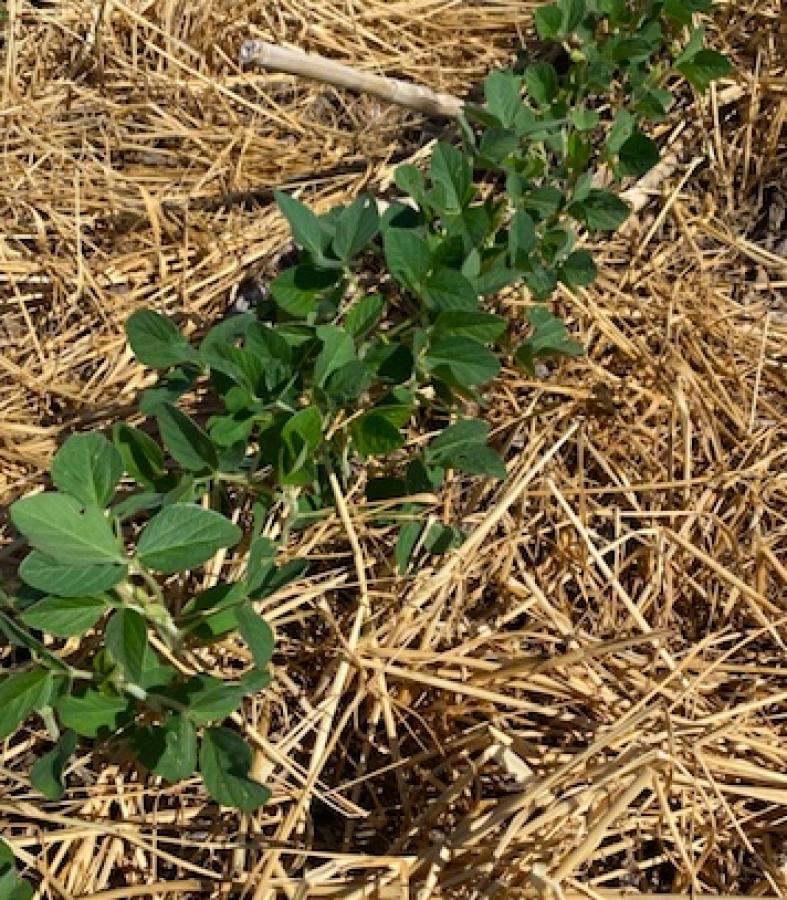
Cereal rye is terminated when it’s 6-8 inches tall just prior to early corn planting. Soybeans are no-tilled into 18-inch-tall cereal rye that’s then terminated within a week. Soybeans are very resilient and can grow through just about anything you throw at them. This spring we no-tilled into thick corn stalk residue and a cereal rye cover and soybeans came up just fine. Knowing this is leading me to consider allowing the cereal rye to continue growing to the point where I could use a roller crimper to terminate it after the soybeans are planted instead of an herbicide.
All the residue is another great reason to no-till soybeans in my book. When you till, you mix all the corn stalks and residue into the soil creating air pockets. No-tilling puts the seed right into consistent soil for better performance.
Better Beans
As a past District 1 director of the Iowa Soybean Association, I got to meet a lot of great farmers and learn about opportunities. There’s a push in the industry to grow better quality soybeans, such as high-oleic soybeans, that are more suitable for a wider range of use. I raise Plenish high oleic soybeans. The oil is highly stable and 20% less saturated fat than commodity soybean oil. It’s better for human consumption and performs better in industrial products. It also earns me a decent premium when I deliver it to the Cenex Harvest States oilseed processing plant up the road at Fairmont, Minn.
They yield great for us, but a significant challenge in growing high-oleic soybeans is they are currently only available with the RoundUp Ready trait. When you have RoundUp resistant waterhemp and marestail, that becomes a problem. It’s a problem we’ve been able to work around with the help of cover crops.
Generally, our cereal rye cover crop generates enough residue to help block those tough weeds. This year we had the chance to see just how effective the cover crops are for weed control. We couldn’t get cover crops on one field that we seeded to high-oleic soybeans. The weeds flourished and it was a mess. It certainly proved how essential the cover crop residue is to our ability to grow this high-value crop.
Cover crops have also helped counter white mold problems. Before we used cover crops, we had to switch from narrow-row soybeans back to 30-inch soybeans when white mold started to become an issue. The shift helped but didn’t eliminate the problem.
With cover crops, we realized white mold became even less of an issue. White mold starts developing early in the season. My theory is when there’s residue on the soil, the spores are somewhat contained and can’t spread to the plant. No matter the reason, the cover crop residue does seem to affect the mold.
We do still see benefit to applying fungicides. Tar spot is a new fungus on the rise. We want to stay ahead of it as it can be a real yield robber. Fungicides are applied to soybeans at R3. Applications on corn are made just before tassel or after pollination.
Maybe in the future I won’t need to apply any fungicides or herbicides thanks to cover crops…or maybe I will. Either way, I look forward to continuing to find the better, more efficient, more economical ways of farming and changing my strategies to capitalize on the advancement.
NO-TILL TAKEAWAYS
– Late spring nitrate testing helps dial in split applications.
– Livestock manure delivers a more complete nutrient package.
– Cover crops create space for specialty crops lacking diverse herbicide resistant traits.